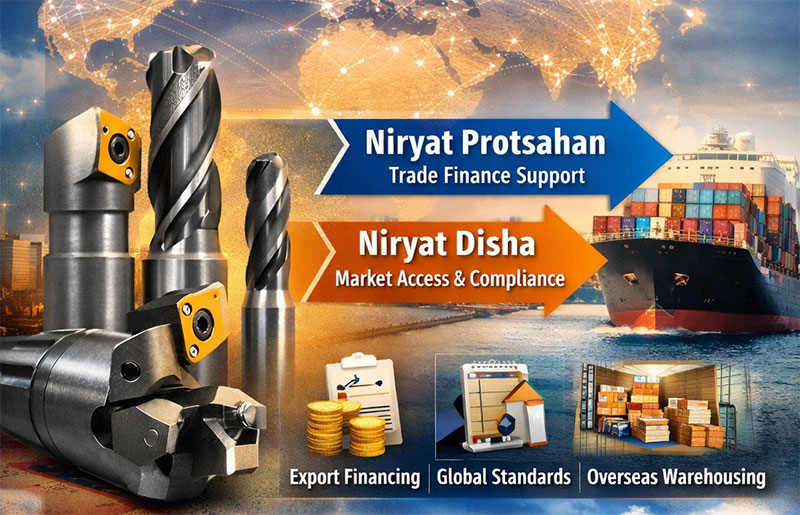
The Export Promotion Mission (EPM), approved by the Government of India in November 2025, is…
Forging the Future: How Next-Gen Lubricants Deliver Flawless Finishes
In the high-stakes world of forging and casting, where extreme temperatures and immense pressures are the norm, the quality and performance of the final product are directly tied to the materials and processes used. Among these, specialty lubricants play a pivotal and often underestimated role, acting as the critical link that ensures efficiency, extends tool life, and maintains the integrity of the finished part. These advanced formulations are no longer just about preventing metal-to-metal contact; they are sophisticated solutions engineered to meet the evolving demands of modern manufacturing.
The market for these specialized products is robust, underscoring their importance to the industry. The global forging lubricant market, for instance, is valued at over $6.5 billion, with projections indicating a steady growth to nearly $10 billion within the next decade. Similarly, the market for aluminum die casting mold release agents, a critical component in casting operations, is valued at hundreds of millions of dollars and is set to expand significantly. This growth is driven by several key factors, including the automotive industry’s relentless push for lightweight components and the increasing need for high-precision parts in sectors like aerospace and industrial equipment.
A primary function of specialty lubricants in forging is to act as a parting agent, preventing the work-piece from sticking to the dies. At temperatures reaching over 1,000°C, these lubricants must form a durable, uniform film that withstands extreme conditions. Beyond this, they serve as thermal insulators, helping to manage die temperatures and reduce thermal shock, which can lead to die cracking and shortened lifespan. The right lubricant can improve die life by a substantial margin, in some cases reducing wear by over 75% and increasing tool life by up to 50%. This directly translates into lower tooling costs and reduced downtime, a major consideration for manufacturers.
In the casting process, particularly in die casting, specialty release agents are indispensable. They create a non-stick barrier between the molten metal and the die cavity, ensuring a clean and easy release of the finished part. Modern casting lubricants are designed to not only prevent sticking but also to facilitate metal flow, enabling the creation of intricate and complex geometries. The shift toward water-based and bio-based lubricants is a significant trend, fueled by tightening environmental regulations and a focus on worker safety. These alternatives offer superior performance while reducing harmful emissions and simplifying waste treatment processes.
Recent advancements in lubricant technology, such as the adoption of nanotechnology, are further revolutionizing the field. These nano-enhanced lubricants incorporate microscopic particles to improve lubricity and heat dissipation, leading to even greater efficiency. The move towards minimum quantity lubrication (MQL) in both forging and casting is also gaining traction, with its promise of drastically reduced fluid consumption and a cleaner shop floor environment. This approach can cut down on lubricant usage by more than 90% while still providing adequate lubrication and cooling.
In essence, specialty lubricants are a cornerstone of modern forging and casting. By protecting costly tools, enhancing part quality, and improving overall process efficiency, they are integral to a manufacturing operation’s success. As industries continue to demand higher performance and greater sustainability, the role of these advanced fluid technologies will only become more critical in shaping the future of metal forming.
Related Posts